
Fillable PDF form softwareTurn any PDF into a form that checks itself.
Start from a blank page, a flat PDF or the PDF form you already use. VectorForms makes it fillable, applies your rules, sends it prefilled, collects signatures, and hands you a flattened PDF and clean data at the end.
PDF to fillable form in minutes
Plain-English rules, with AI help
No-code, drag-and-drop editor
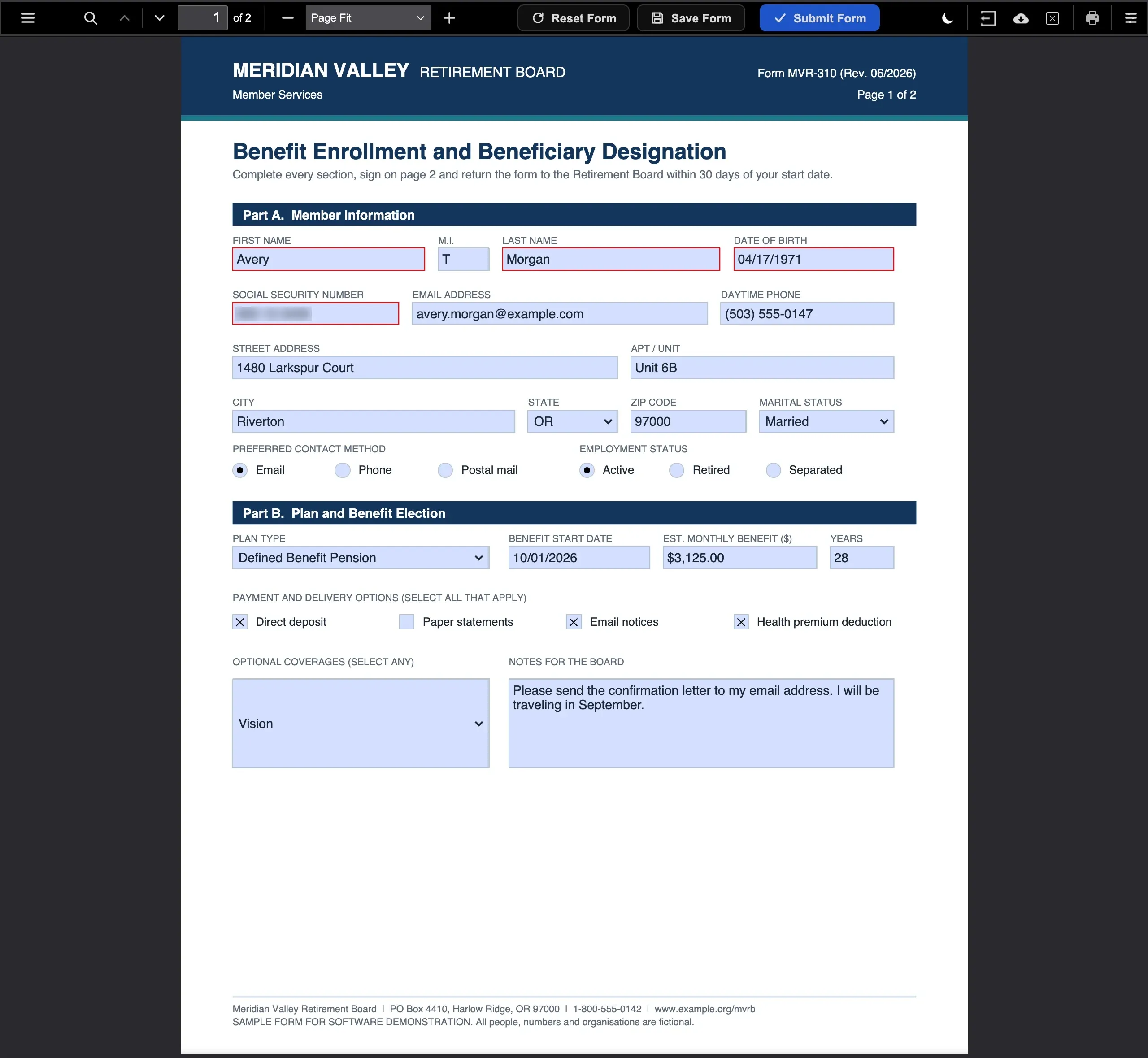
Paper forms fail in the same few ways every time. A missing date. The wrong box ticked. Shares that add up to 90%. A signature left off page four. Each one costs a phone call and a week.
VectorForms catches those mistakes while the person is still filling the form in. Required fields stay outlined until they’re right, calculations do themselves, and sections appear only when they apply.
You don’t have to redesign anything to get there. Start from the PDF you already send out. VectorForms maps its fields, and you add the rules on top.
The life of a form
From a blank page to a signed record, and the data behind it.
Ten steps, one product. Your team sets up the first four once. Every form after that runs the other six on its own.
Build
Once, by your team
Steps 1–2 · Build
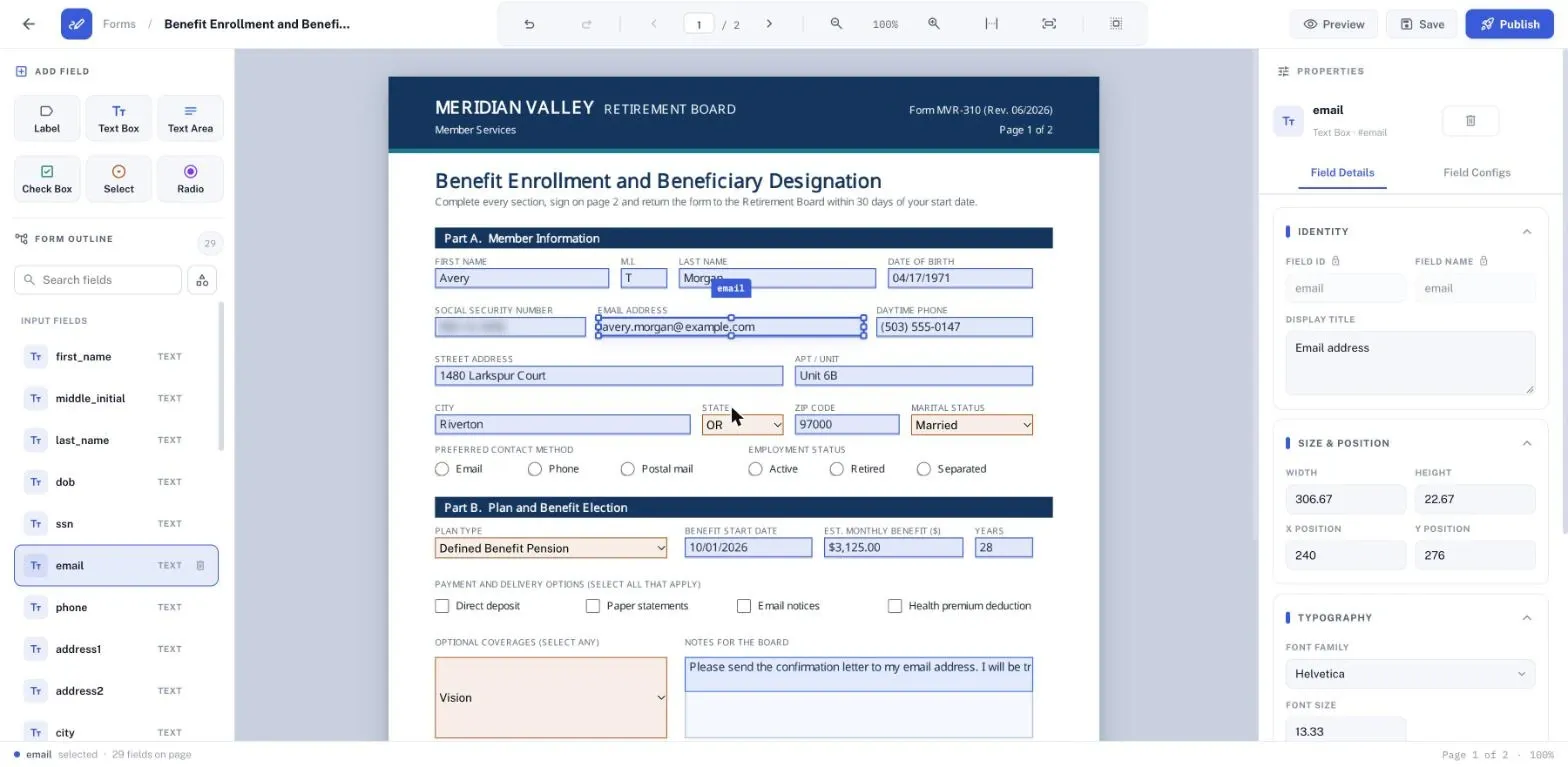
Start with whatever you have.
A blank page, a PDF you already send out, or the fillable PDF you already use. Any of them can become a working online form in the same designer.
- Upload a PDF and VectorForms maps its form fields. You adjust them instead of starting over.
- Or start from a blank page and drag on labels, text boxes, text areas, checkboxes, selects and radio buttons.
- Templates per client and environment that you can switch off without deleting.
Step 3 · BuildNew
Teach the form your rules, in plain English.
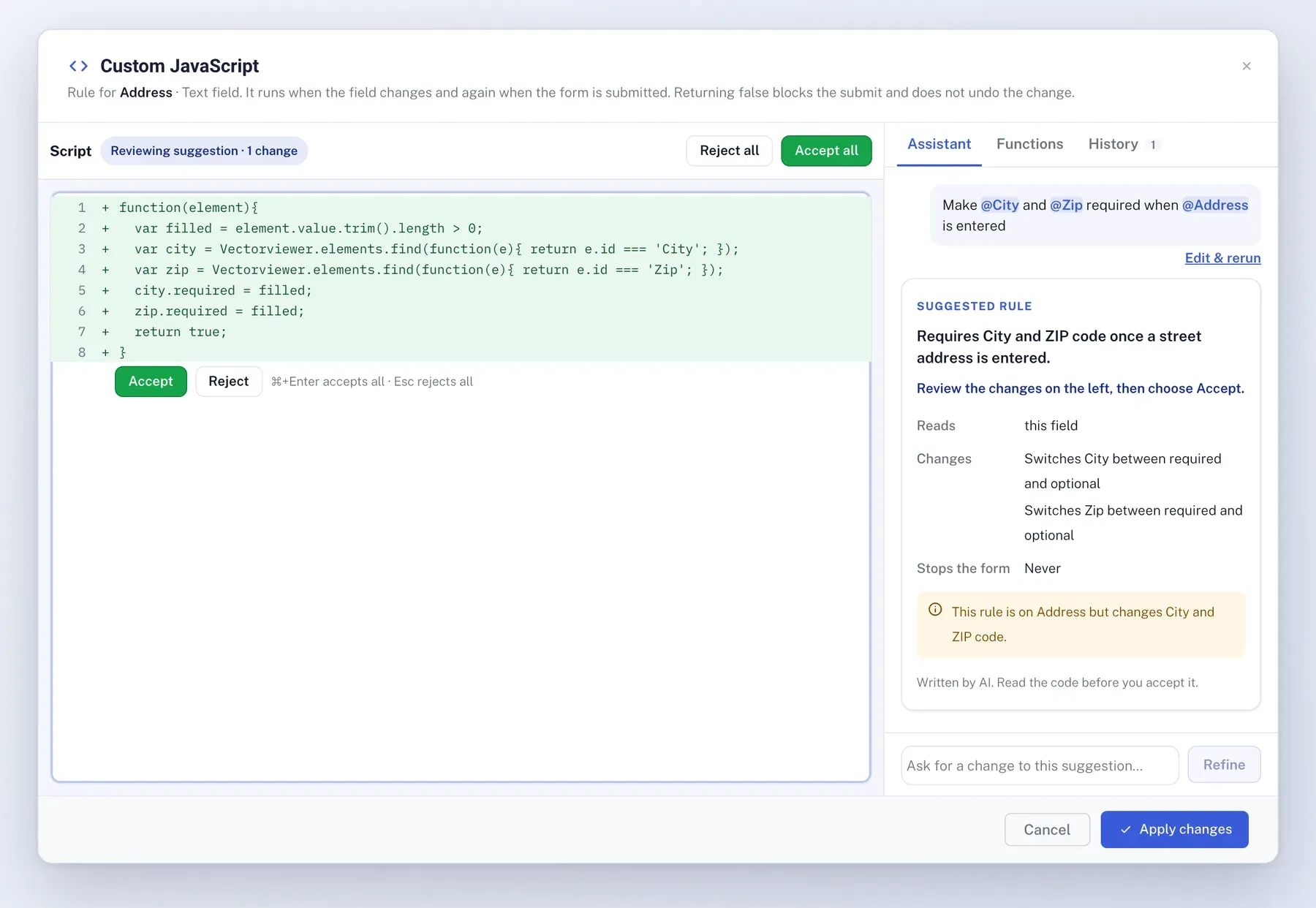
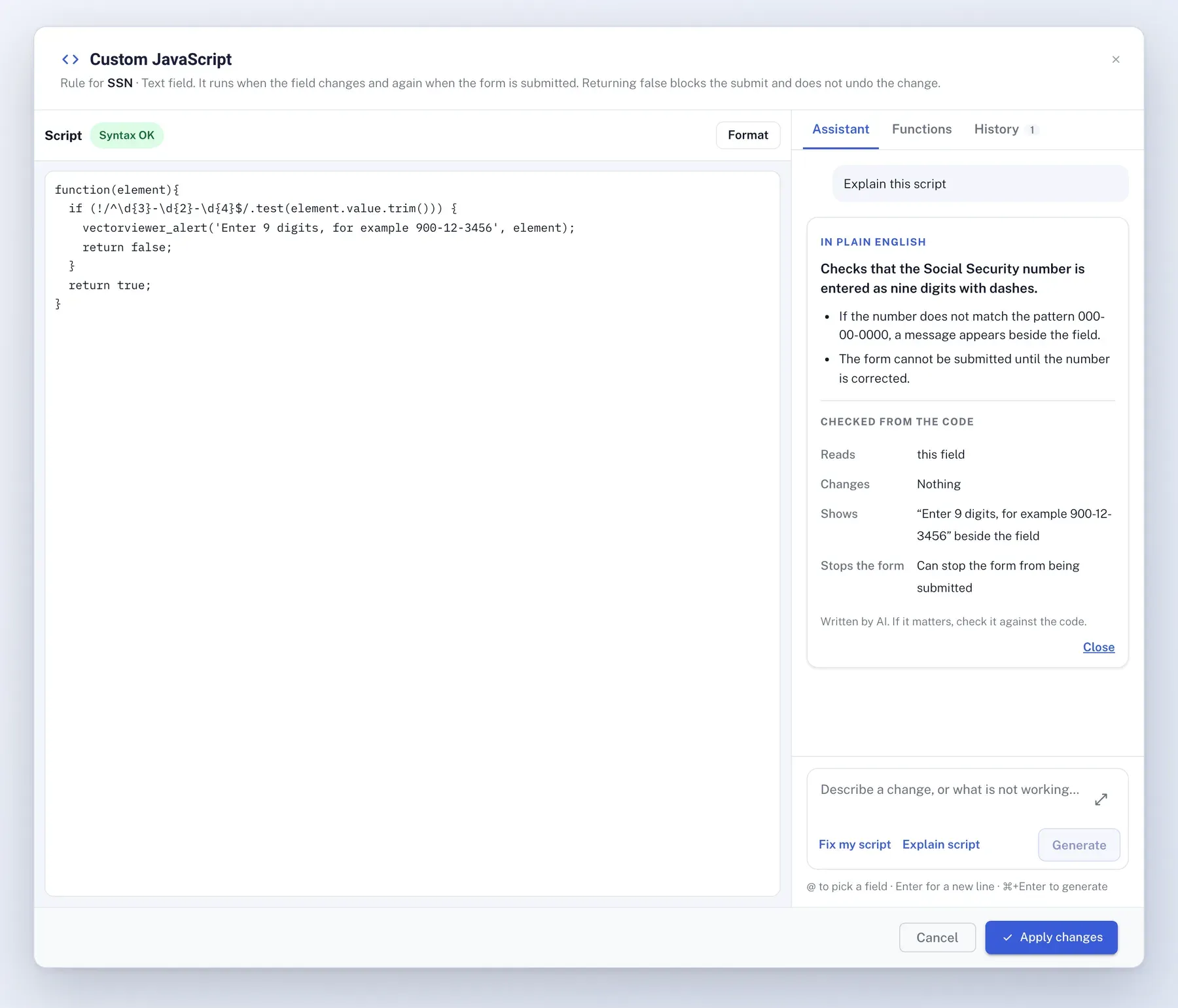
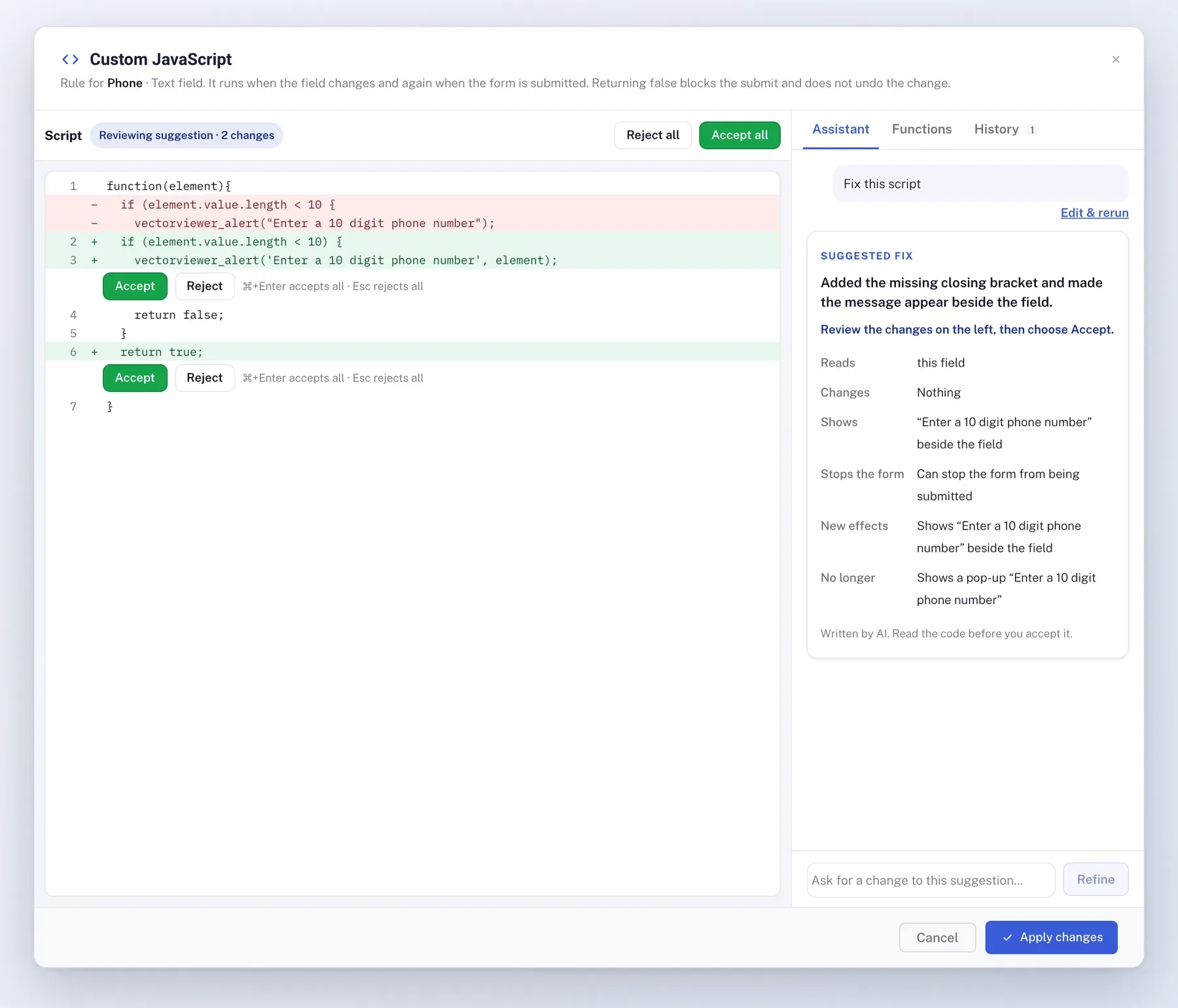
Describe a rule in a sentence and the assistant writes the script. Or take one you already have and ask it to explain it, or to fix it. Either way, you read the result before anything changes.
- Required, numeric, date and masked fields so nothing arrives half done.
- Describe a rule and the assistant writes the script. Type @ to pick a field, even one on another page.
- Review every change line by line, and accept or reject each one. Nothing is live until you publish the form.
- Explain a script in plain English, or have a broken one repaired.
Step 4 · Build
Decide who does what, and how they sign.
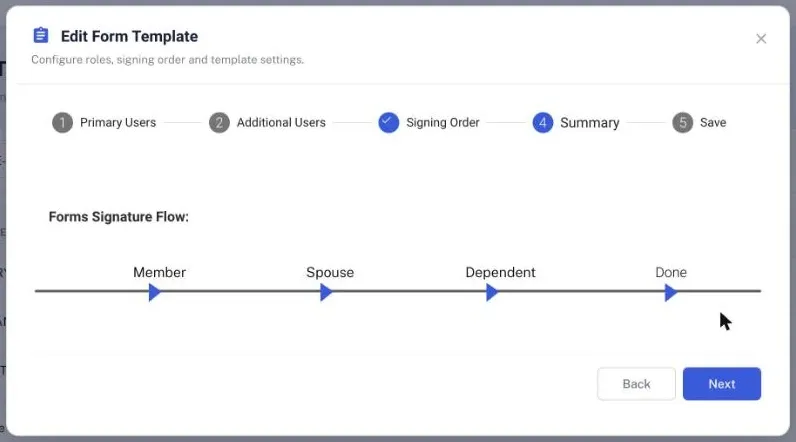
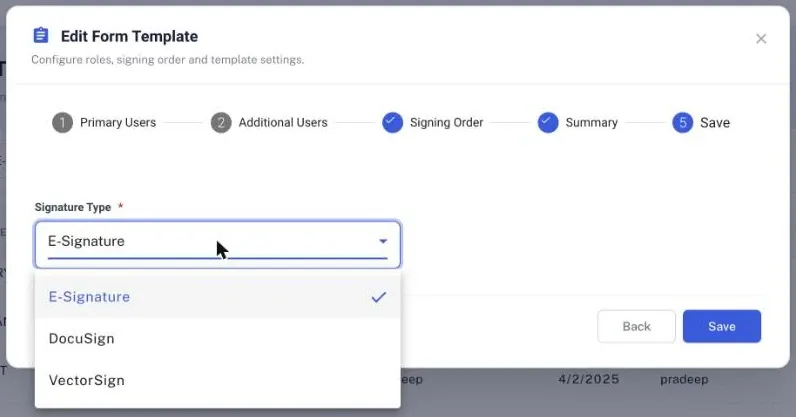
Name the roles on the form, set the order they sign in, and choose the signature type. Signatures are optional, and you choose the kind.
- Roles and signing order such as member, then spouse, then dependent. Each sees only the fields their role allows.
- E-Signature drawn or typed right on the form, when that’s all a form needs.
- DocuSign if you already have an account. The completed form is routed through it.
- VectorSign for signer authentication and a tamper-evident certificate, all in the same suite.
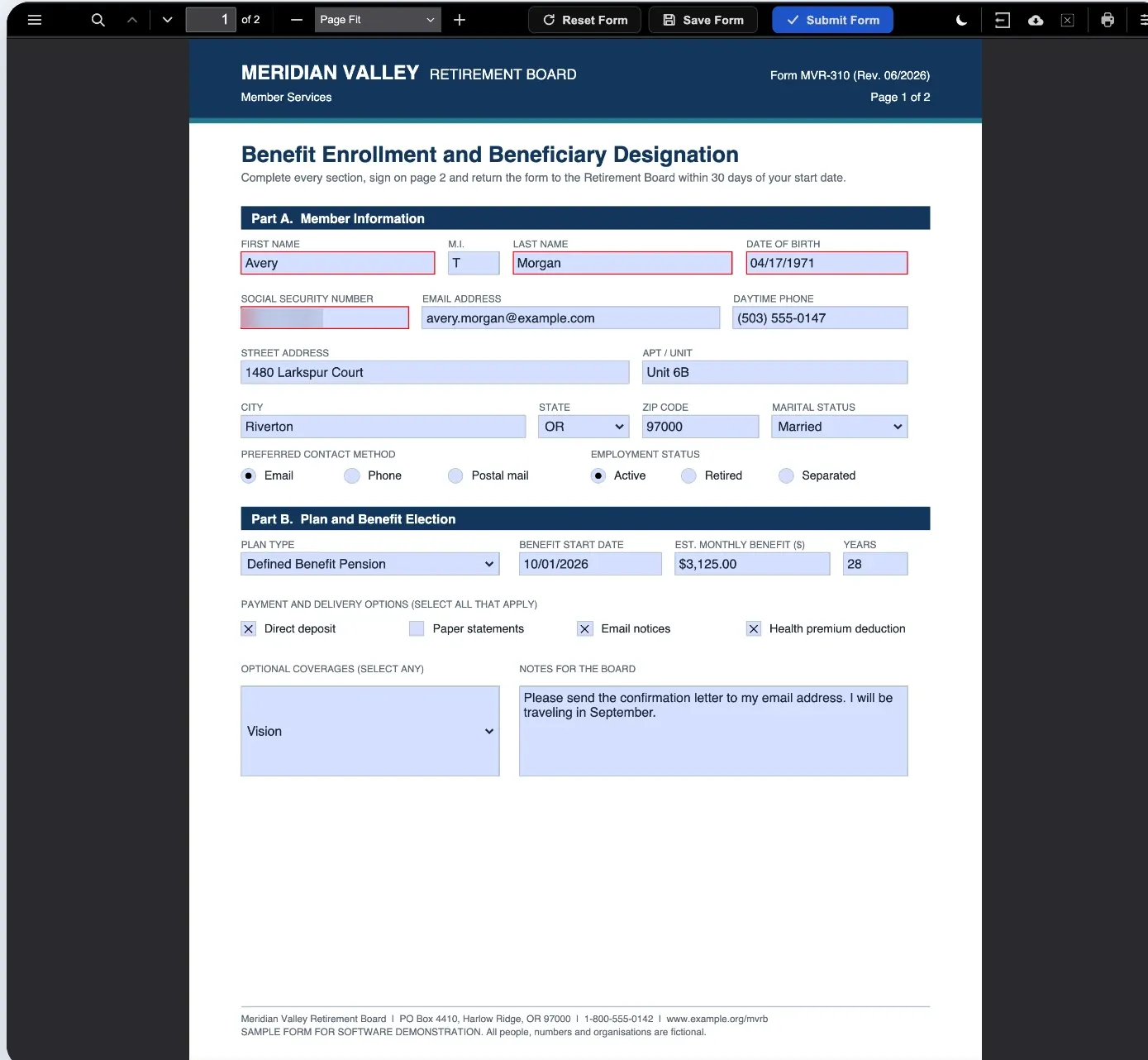
"fields": { "first_name": { "value": "Avery" }, … }
"plan_type": { "value": "Defined Benefit Pension", "readonly": "true" }
→ 200 · a secure link for the recipient
Step 5 · Send
Send it with what you already know.
Start a form for one person from the dashboard, or from your own application with one API call. Whatever you already hold about them is filled in before they open it.
- Prefilled from your records so people check their details instead of typing them again.
- Read-only where it matters so a plan or an ID can’t be changed by the recipient.
- A secure link per recipient with no account to create and nothing to install.
Steps 6–7 · Complete
The recipient finishes it in one sitting.
On a phone or a laptop, they add what’s missing, attach anything the rules ask for, sign, and submit. If they run out of time, they save the form and come back to it later.
- Fields that follow their answers because dependencies tie one field to another.
- Errors shown in place with the field outlined until it’s right.
- Submit stays locked until every required field, rule and signature is done.
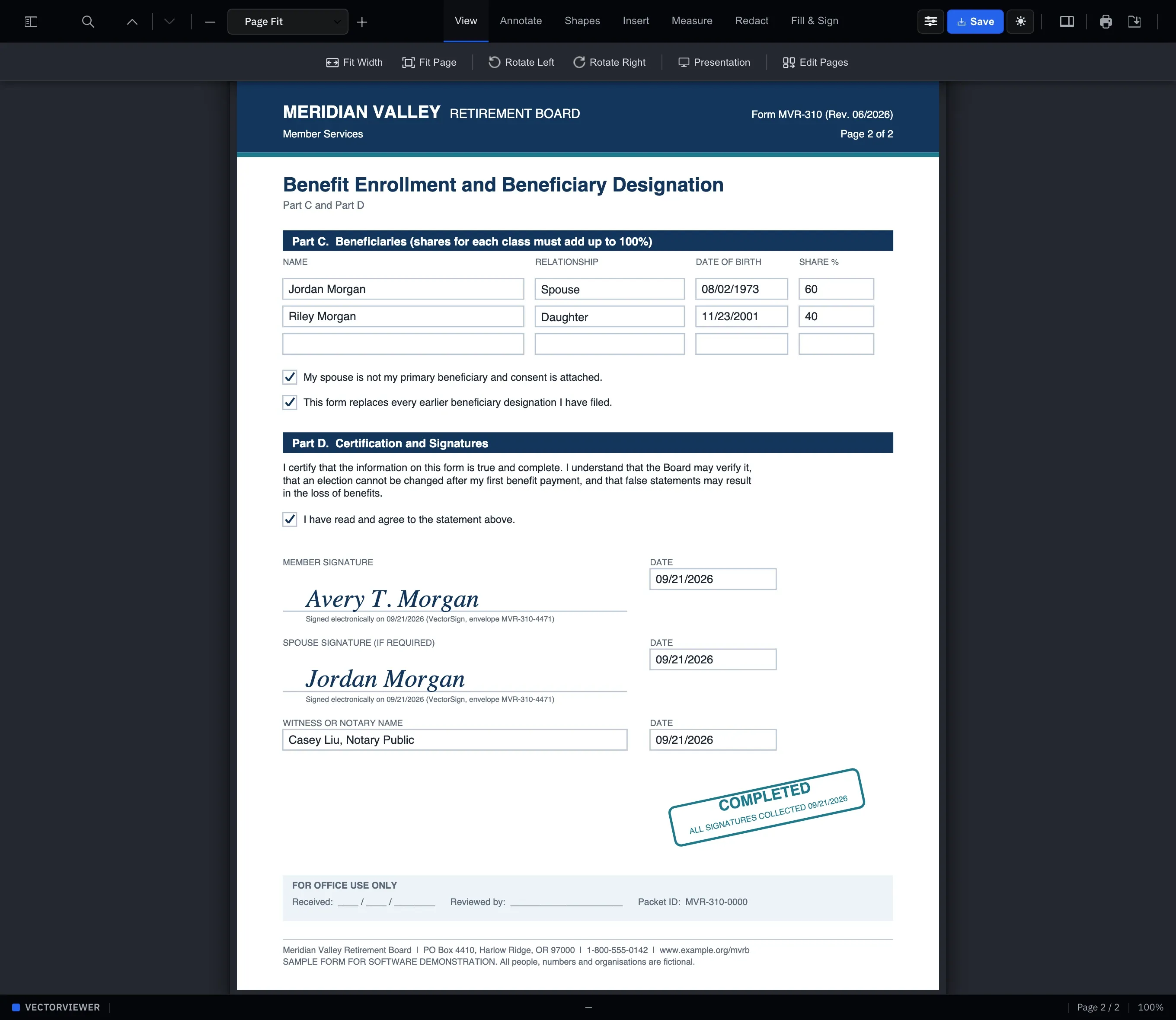
Beneficiary designation · page 2 of 2
Saved · finish later- Adds what’s missingBeneficiaries and shares
- Attaches a documentspousal-consent.pdf · 1.2 MB
- SignsAvery T. Morgan
- SubmitsAllowed once every rule passes
- CreatedPublished and sent
- SavedStarted, not finished
- SubmittedComplete and validated
- SignedSignature captured
- VerifiedPassed your review
- InductedFiled as a managed document
Steps 8–9 · Keep
Review it, approve it, and file it.
Each submission arrives complete and validated. Your reviewer opens it in VectorViewer and approves it. VectorForms then flattens it into a final PDF and files it in the cloud.
- Every form has a status from Created to Inducted, so nobody has to chase.
- Review with the assistant and annotate on a layer that never touches the submitted form.
- Flattening prints every field and signature into the page, so they become part of the document.
- Open it any time in VectorViewer from the cloud, with its version history and permissions.
Step 10 · Keep
Keep the data, not just the PDF.
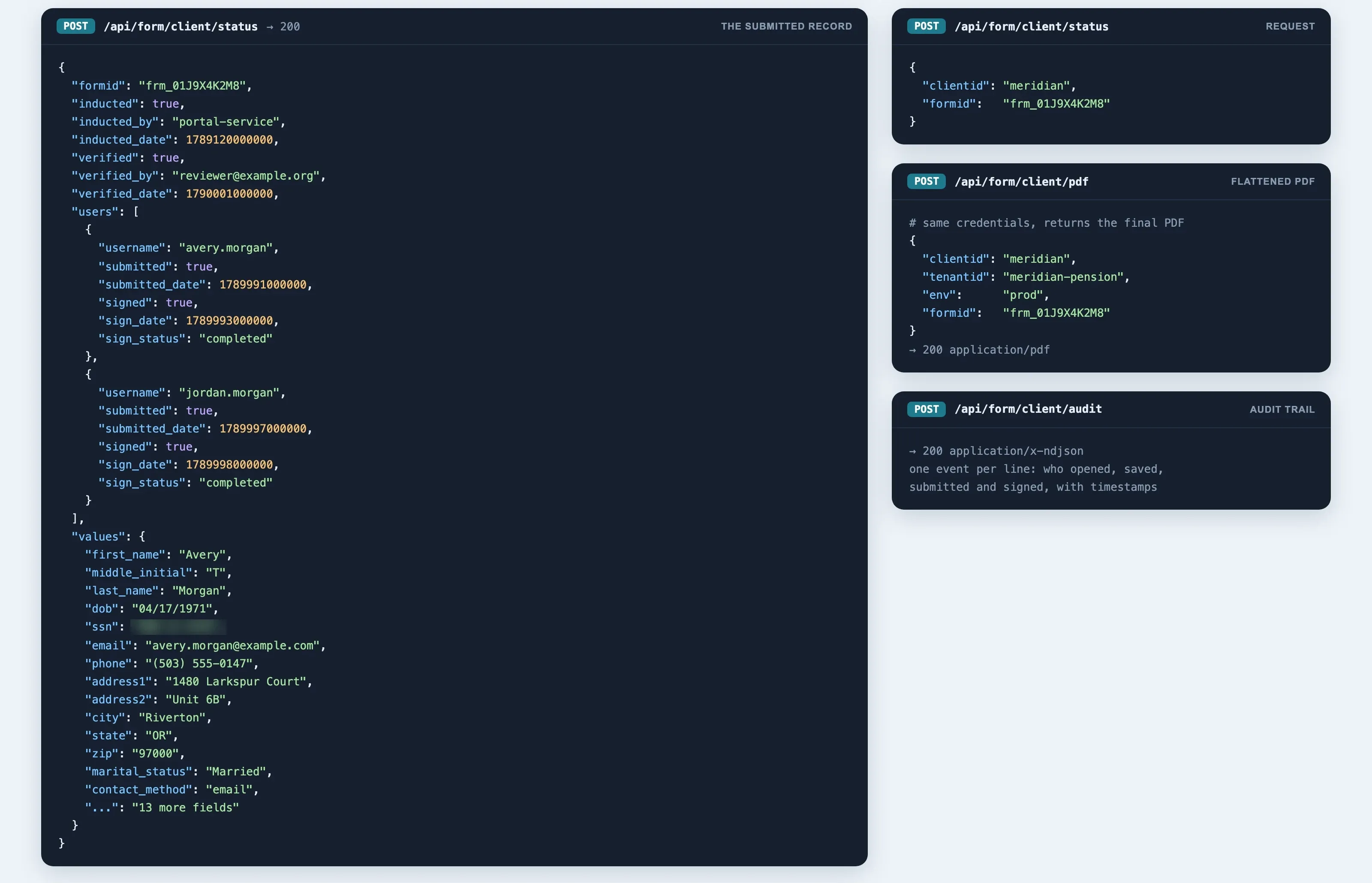
Every value a person entered is also saved on its own, as structured data. The PDF is the record people read. The data is what your systems use.
/api/form/client/statusreturns every value the person entered, with who submitted and signed, and when./api/form/client/pdfreturns the flattened PDF, with the same credentials./api/form/client/auditreturns the audit trail, one event per line.- Saved with the submissionso it can prefill the next form, or update your CRM, core system or any other database.
What people ask about VectorForms.
Can we convert the PDFs we already have?
Yes. Upload a PDF and VectorForms maps its form fields. Then adjust the mapping and add your rules.
What kinds of rules can we add?
Required fields, validation, calculations, dependencies between fields, roles that decide who completes each part, and custom JavaScript, which the AI rule assistant can write from a plain-English description.
Do we need to know JavaScript to write rules?
No. Describe the rule in plain English and the AI assistant writes the script, which you review before it goes in. Many rules need no script at all: required, numeric, date and masked fields are settings. To try a rule, use the designer’s preview. Explanations are in English.
What does the rule assistant see?
The request you type, the ids, titles, types, pages, required flags and options of the form’s fields, and the script you’re working on. It doesn’t receive what people enter in the form. Your request is screened for personal data before it reaches the model, and each call is logged. It runs on Amazon Bedrock, in the same AWS account as your deployment.
Can we switch it off?
Yes. It’s off until an administrator turns it on, for each tenant and environment, in Settings. When it’s off, the designer looks and works exactly as it did before, and sends no AI requests.
Can we start without a PDF?
Yes. Build a form from a blank page in the editor.
Can a form require signatures?
Yes, and you choose how: a built-in e-signature drawn or typed on the form, your existing DocuSign account, or VectorSign. A form can require one or more signers, in the order you set, before it can be submitted.
What happens to a form after it’s approved?
VectorForms flattens it into a final PDF, with every field and signature printed into the page, and files it as a managed document. You can open it in VectorViewer from the cloud at any time.
Can we use the submitted data elsewhere?
Yes. Every value is saved as structured data alongside the PDF, and the client API returns it with who submitted and signed. Use it to prefill the next form, or to update your CRM, core system or database.